
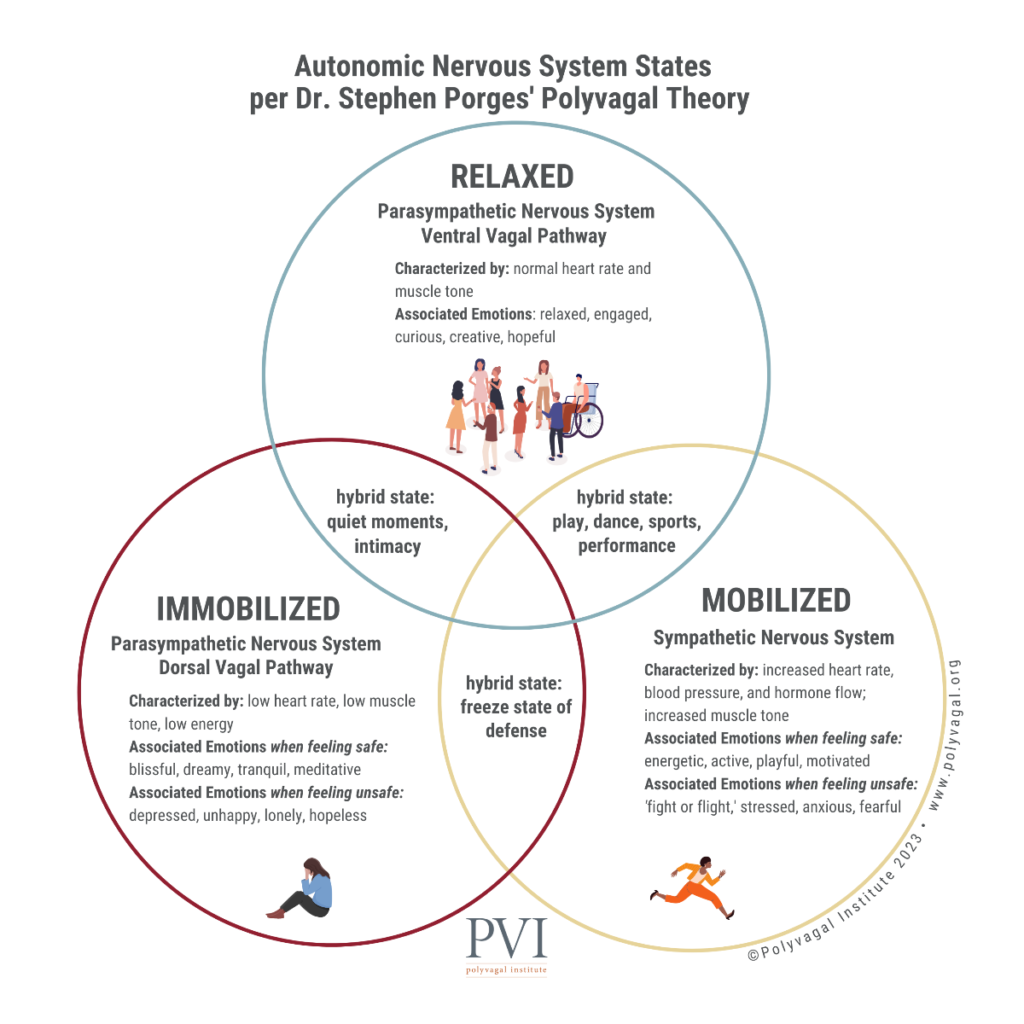
The Polyvagal Theory (PVT) offers useful insight into what drives conflict. Based on hard neurobiology science, PVT describes behavior governed by the autonomic nervous system such as the fight/flight/freeze system (FFF) and Social Engagement System (SES).
Simply put, PVT posits that all people, are always, to some degree always in either a FFF or SES state. They are always in a withdrawal or approach state. The energy associated with the state may be barely visible, or strong enough to take virtually complete control of a person, including basic bodily functions.
Here’s a story about the FFF system taking control, even though there was no apparent need for system activation.
Two relevant aspects for lawyers
PVT research establishes that when in an intense FFF state, hearing is physically impacted. What people can literally hear is reduced as the autonomic nervous system focuses to listen for danger signals. Also impacted is access to the broadest range of information processing and relational strategies. The FFF system restricts the neural system to process only what is necessary or immediate survival.
When people are in an SES state, the neural system opens up to allow curiosity and vulnerability in a relationship with another person or group. They are able to hear and perceive new information, and information contrary to what they may have previously thought.
ICMM relevance
The Integrative Client-Centered Model (ICCM) asserts that clients are typically in a FFF state when they first come in for help. (This can last throughout the counseling process.) The level of intensity is usually not a total, overwhelming state of fight, flight, or freeze, although it can be. The ICCM holds that counselors (lawyers, therapists, doctors, clergy, etc.) can help clients make better decisions by helping them move from a FFF state to a SES state before choices have to be made.
This is done by establishing a safe and trusted relationship. ICCM tools and techniques are designed to support this.
PVT is a rich and complex theory, and understanding it helps counselors in a variety of ways. PVT was developed by Dr. Stephen Porges, who has several books describing the process. Dr. Porges also has many of his lectures available to watch on YouTube.