
By Mark Baumann, 2026
Pay-as-You-Go is an ethical and client-centered billing method which can reduce uncollected fees. It allows lawyers to rely less on the advance fee (“retainer”) and trust accounting system, or even to eliminate it. PAYG naturally helps lawyers improve their customer service. I closed my IOLTA trust account years ago and use PAYG exclusively. Clients love it.
For lawyers the trust account billing system is normal and maybe even comfortable and PAYG is alien. For clients it’s the opposite.
In this article I will talk about billing ethics, how I learned to make PAYG work for me, useful client counseling skills, some billing practices, risky clients, uncollectable fees, trial fees, clients with limited funds, and how to hold client funds if you don’t have a trust account.
PAYG is not for all lawyers. I am a family law practitioner. In my past I practiced in a variety of legal areas. I think PAYG can work in many areas of law, but certainly not all.
While I don’t use a hybrid system, there is nothing wrong with combining PAYG with advance fee deposits. For example, you can use PAYG and then for trial use a trust account or flat fee system.
If you are curious, I suggest trying it out for a while. I experimented with PAYG. At first I didn’t think it would work, but over a year I learned how to make it work and gained 90% confidence in the system. I gave myself another year before I closed my trust account.
Is PAYG ethical?
Absolutely. There is no Rule of Professional Conduct which prohibits it, at least in Washington State. Fees are governed by RPC 1.5.
Sandra Schilling is a Professional Responsibility Counsel for the WSBA and Ethics Hotline staffer. Sandra and I will give a CLE presentation for an ethics credit about the topics in this post on June 26, 2026 at the STAR conference in Ellensburg, WA.
Are lawyers required to have a trust account? Absolutely not. At least so long as you don’t take any advance fees or hold funds for clients. Advance fees are governed by RPC 1.15A.
If you do have a trust account, you can still use PAYG and don’t have to put the fee into the trust account so long as you take payment after service is provided.
PAYG can be used with true retainers. Most people use the word “retainer” to describe advance fee deposits. In Washington State, a retainer is a fee to secure availability and additional fees for service are expected. Retainers don’t seem necessary to my practice, but they might be useful for yours. See RPC 1.5, comment 13.
PAYG is not a flat fee. (FYI, flat fees cannot be placed in a trust account. See RPC 1.5, comments 12, 14, and 15 and RPC 1.15A.)
How I make it work
Setting expectations is important. I explain PAYG in the first screening call.
My first paid meeting with clients is usually a couple of hours long. At the beginning I remind them what my billing rate is and that at the end of the meeting I will charge their card before we end the meeting. When the meeting is coming to an end, I ask them how they feel and check to see if they are comfortable with the case approaches we developed. I note how much time we spent and what the charge is and I ask them if it’s okay to charge their card. After I collect and enter their card info and before I click the “process charge” button I ask, for a third time during this meeting, if it’s okay to charge their card for the amount owing. At this point the expectation for the client to pay for the service as incurred has been established.
On the flip side, the client expects to receive a service which provides value to them. I need to use good client counseling and communication skills. Giving clients choices goes a long way to helping them feel comfortable and satisfied.
Putting as much of the decision making process as possible into their hands can also put responsibility for the outcome onto their shoulders. I think this also encourages the clients to work harder to help themselves.
Research on what clients want shows two things are that they want to understand what is going on in their case and they want to have input. For younger lawyers, I think meeting these needs helps the clients have confidence in your skills and patience if you need to do research on their legal issues. Check in with the client frequently to see how they feel about what’s going on and if they think the action plan or expectations need adjustment.
Legal client counseling skills
I designed the Integrative Client-Centered Model (ICCM) for legal client counseling specifically to promote optimal client protection, safety, decision making, and choices. I ported many of the ICCM client counseling techniques from well-established and science-based mental health counseling models, so there are many free sources to learn counseling techniques. The key is to continually work on developing your communication skills.
The most important techniques are good listening skills, combined with an enhanced emotion vocabulary and a lack of fear of talking about emotions. (Tip: print out some version of the Feelings Wheel, keep it handy and reference it to help you learn to identify feelings the client is experiencing.)
The LAAoR’d approach
One tool I use to optimize client choice is to clarify for them that I provide service on three levels, as a lawyer, an attorney, and/or an attorney of record (LAAoR).
As a lawyer I advise, draft and coach.
As an attorney, I can also negotiate and represent in mediation.
As an attorney of record, I can appear with a general Notice of Appearance, or (in Washington State) I can appear with a Notice of Limited Appearance (NOLA) to represent only for a specifically identified part of the litigation.
I have completed cases serving solely in just one of the LAAoR levels, and I often move in an out of service layers throughout a case. LAAoR works great for clients who can’t afford my representation at trial. In those cases I begin teaching them how to take over their case from the very beginning, and offer to remain as a coach until the end.
Here’s an article talking more about the LAAoR service levels.
A surprise benefit
I have a good bit of training and experience with client counseling skills. After using PAYG exclusively for a year or so, I was surprised to notice that my client relationships were significantly improved. I’m still reflecting on why that is. For now, and given my LAAoR approach, I think it’s primarily because virtually any given contact with a client could be my last. In every contact it’s in my mind to be sensitive to and do my best to meet the client’s in-the-moment and long-term needs. PAYG naturally motivates me to set a healthy expectation of myself.
Maybe that shouldn’t have been a surprise.
Some specific PAYG billing practices
I take virtually all payments through a credit or debit card. I think PAYG could work with a check/cash only system, and that might involve some additional techniques and/or a specific type of law practice to make it work smoothly.
When I charge for the first meeting, I tell the client their card information will be stored in my credit card processing program for a time. I assure them that I will never re-charge their card without asking their permission first.
The first few months I used PAYG I was quite nervous that I wouldn’t be paid for follow up work. I quickly learned that fear was unjustified. I found quite the opposite, that clients are far more likely to pay for small amounts close in time to the work being done than come up with an additional large advance fee deposit.
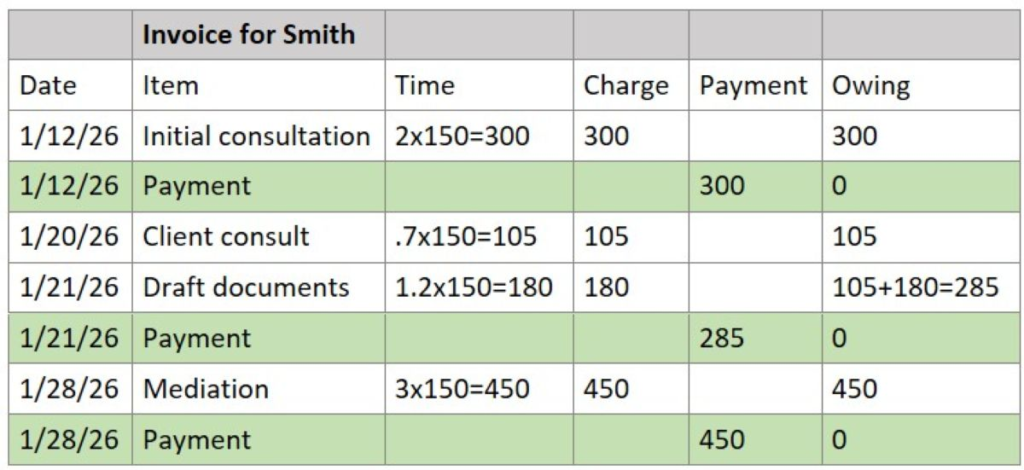
My invoices are sent by email and include a short in-line table, like the image above, showing the date, activity, time, rate, charge and amount owing, and the prior payment. I invite clients to review for accuracy and call with questions, and request permission to recharge their card. Quickly clients learn to trust the system and respond immediately or promptly with “Yes.” The billing process is quick and easy for both the client and I.
No more end of the month billing days.
How frequently do I send a billing invoice?
The frequency of my invoices vary for each client. Sometimes I send invoices for every day’s work, or a couple of days work, and sometimes I send a collection of charges over several weeks or months. I try to send invoices before major events like a hearing or trial setting. For clients with high incomes who earn my confidence I tend to send fewer and larger invoices.
What about trial fees?
I have used PAYG for 3-day trials. The clients had earned my trust, and I had earned theirs. Their funding sources were clear to me. Certainly, we had discussions about the daily cost of trial and the clients ability to pay the cost at the end of each day of trial. This may not work for everyone, so using an IOLTA trust account system for trial fees is okay for those who want to maintain a trust account.
Risky clients
I think it’s important to pay attention and notice when clients give any indication of hesitancy in paying. Sometimes you can hear it in a slight hesitation in their prosody. I can usually avoids problems from developing if I get out in front of the issue. I connect with the client and take the opportunity to check in with them to see if they feel my service and the action plan has value to them. If needed, we revisit the action plan options.
With the LAAoR system, and using a Notice of Limited Appearance, it’s easy to readjust my role in their case. Using a NOLA to enter a case, it’s easier to terminate services for a non-paying client.
Uncollected fees
In the years I used the advance fee and IOLTA trust system (most of my career), I lost a lot of money in uncollectable fees.
A lot.
With PAYG, I’ve had a non-paying client once a year at most. One of those was a domestic violence protection order case and I chose to stay in the case because the client’s funding source didn’t materialize and their life was in danger.
What if the client runs out of money?
The client’s ability to fund legal services should be discussed in an early meeting. It’s best to develop action plans with fee costs in mind. If the client has limited funds, or it’s possible they may need to go to trial and won’t be able to afford attorney services, then I start educating the client on how to handle their case immediately.
We usually don’t know how a case may be resolved, so for most clients I start the education process right away. Another surprise for me was that many clients are quite happy to start drafting pleadings using the court’s forms. Even some of my doctor clients. Many clients are quite happy to file documents with the Court Clerk.
For clients who choose to take on tasks like these, they are nice ways to help them gain confidence in their case regardless of the LAAoR role I take. The courthouse and the litigation process becomes more transparent and less scary.
What do I do if I need to hold client funds and I don’t have a trust account?
Since I don’t have a trust account I can’t hold any money for a client.
In years past, I sometimes held client funds in my trust account. Now, I use other methods if necessary.
If I want, I can open a trust account just for the specific client funds, although I haven’t had to do that since I committed to using PAYG. With a court order, the other lawyer can hold the funds or we can deposit the funds with the Court Clerk who will hold them. I have obtained court orders directing my (trustworthy) client to hold the funds in a dedicated account, not to spend any of the funds, and to provide monthly account statements to the other party. Sometimes, the hassle of dealing with holding a large amount of money motivates parties to settle.
Do it your way
These legal business practices, PAYG, LAAoR, NOLA, can be used in any combination. They require skills so take your time to develop them.
If you try these out, I would enjoy hearing how you combined them and made them work for you and what your practice area is. Likewise, please let me know why they might not work for you.